
THE QUESTION WAS NEVER WHETHER THE OLD AND NEW WERE THE SAME.
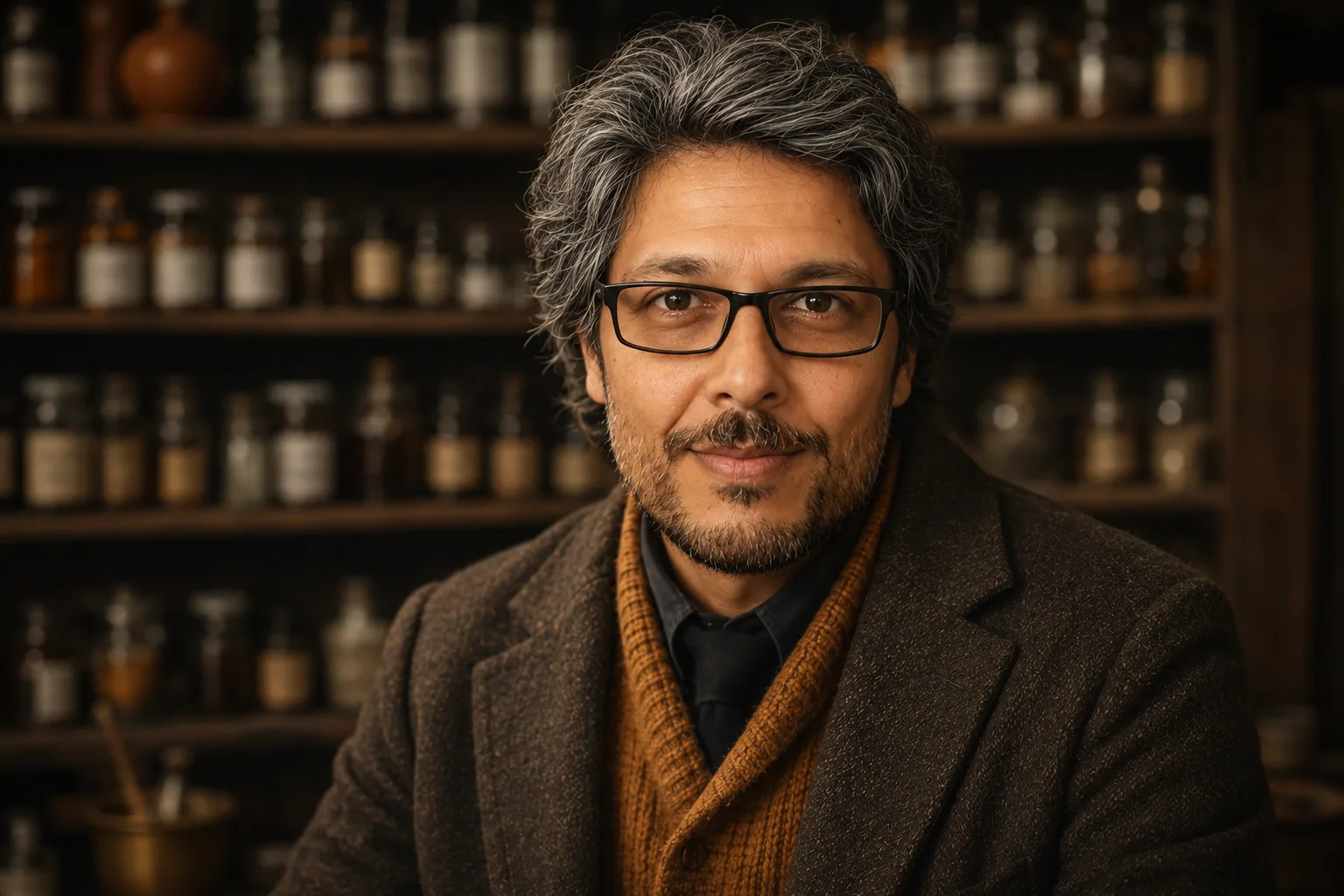
The Author’s Path
Amit Gupta, MD came to this work from medicine and healthcare, but the question that eventually became Amitaeus was larger than either: why can two people receive the same diagnosis, the same recommendation, even the same treatment — and respond so differently?
Modern medicine offered extraordinary precision in pathology, testing, intervention, and disease classification. Traditional medical systems offered another kind of precision: close observation of constitution, qualities, rhythm, environment, digestion, response, and the changing condition of the individual.
Rather than asking one tradition to validate another, Amit began studying classical medical texts and scholarly translations across Ayurveda, Chinese medicine, and Greek medicine, looking for the questions they held in common and the places where their observations could still sharpen modern thinking.
Why Amitaeus
The traditions explored in these books are not identical. Their metaphysics, diagnostic methods, terminology, and therapeutic systems differ. Amitaeus does not collapse them into a single ancient medicine.
Instead, the books look for recurring functional patterns that can be described clearly enough for a modern reader to examine: movement, transformation, structure, qualities, inputs, adaptation, accumulation, recovery, and balance.
The three-force language emerged from that effort.
In 2001, Gupta developed HealthcareIRA™, an early consumer-owned healthcare account model, filed the foundational patent work, and subsequently worked with Congressional healthcare leadership on concepts that preceded enactment of Health Savings Accounts in 2003.
Read the professional historyThe goal is not to move medicine backward. It is to recover useful ways of seeing and carry them forward.
Amitaeus’ Holistic Healing Manual is the foundational volume. Future books will take that foundation into more specific questions, including how individual patterns might change the design of prevention, health management, chronic-condition support, care management, utilization management, and other systems that often begin with the average rather than the individual.
View CV & Publications